


Comment fabriquer le verre trempé

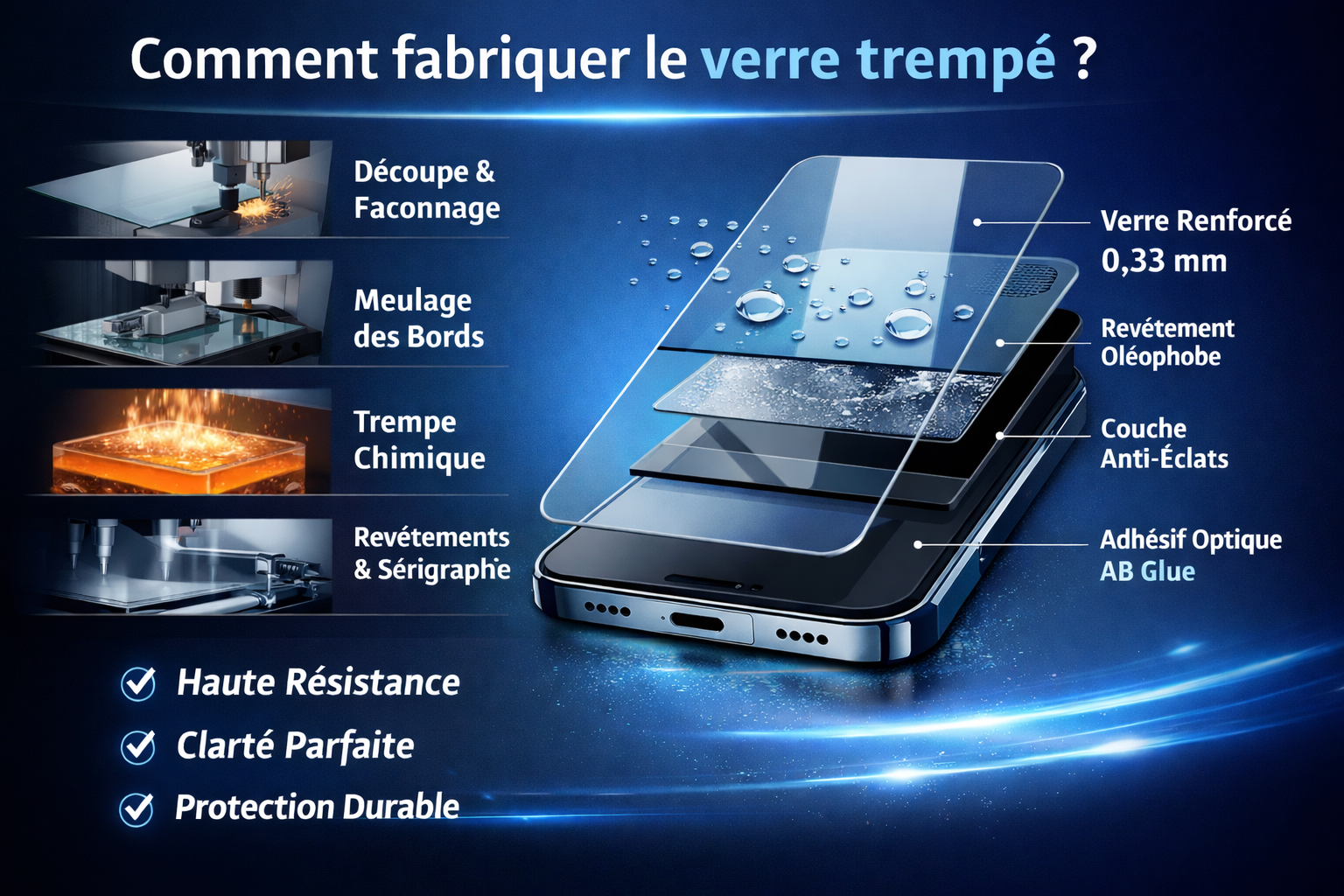
Comment fabriquer le verre trempé ?
La fabrication du verre trempé comprend plusieurs étapes techniques telles que la découpe, le meulage et la trempe chimique, permettant d’obtenir un verre renforcé, résistant aux chocs et aux rayures.
How is tempered glass manufactured?
The manufacturing of tempered glass involves several technical steps such as cutting, grinding, and chemical tempering, resulting in reinforced glass that is resistant to shocks and scratches.
Tempered Glass Manufacturing Process
(Screen protector film – standard thickness 0.33 mm)
1. Raw Material Selection
Production begins with high-quality aluminosilicate float glass, with a standard thickness of 0.33 mm (tolerance ±0.02 mm).
The glass must be free of bubbles, micro-cracks, and internal stresses.
2. Precision Cutting
Large sheets are cut to specific smartphone model dimensions using high-precision CNC machines or laser cutting.
3. Edge Grinding and Polishing
The contours are worked by CNC grinding to achieve specific finishes:
- 2.5D (slightly rounded edges)
- 3D (full curvature adapted for curved screens)
This step improves safety, aesthetics, and tactile comfort.
4. Chemical Tempering (Ion Exchange Reinforcement)
The glass is immersed in a bath of molten potassium nitrate (KNO₃) at approximately 400 °C.
Sodium ions (Na⁺) on the surface are replaced by larger potassium ions (K⁺), creating surface compression stress.
Result:
- Mechanical strength increased by 4 to 6 times
- Better resistance to shocks and bending
5. Ultrasonic Cleaning
Ultrasonic tank cleaning eliminates all dust, oil, or residue.
A perfectly clean surface is essential for the adhesion of subsequent treatments.
6. Functional Coating Application
Several layers are applied via vacuum deposition or plasma treatment:
- Oleophobic coating: anti-fingerprint
- Anti-reflective (AR) coating: improves light transmission
- Anti-shatter layer: limits fragment dispersion in case of breakage
Final light transmission: generally ≥ 90–92 %.
7. Screen Printing (Border Printing)
Black borders or decorative elements are applied via screen printing and then cured at high temperatures to ensure durability.
8. Optical Adhesive Application
A layer of optical glue (AB glue) is applied evenly on the back side to ensure:
- Perfect adhesion
- Bubble-free installation
- Optimal touch sensitivity
9. Quality Control
Each piece undergoes rigorous testing:
- Visual inspection (defects, dust)
- Hardness test: 9H (pencil hardness scale)
- Impact resistance test
- Light transmission test
- Dimensional control and thickness tolerance
10. Final Cleaning and Packaging
After validation:
- Clean room cleaning
- Peelable film protection
- Individual packaging with installation accessories
- Packaging in retail-ready boxes